
Glossary
Aquarium and living wall terms, one sentence each.
The words the work runs on — from the sump in the cabinet and the protein skimmer in it to alkalinity, drip lines and a koi pond’s winter shutdown — each defined first in a sentence, for the firms that look after their clients’ aquariums and living walls.
Coming soonWaitlist open
Claim early accessOne display, top to bottom
From the light down to the sump.
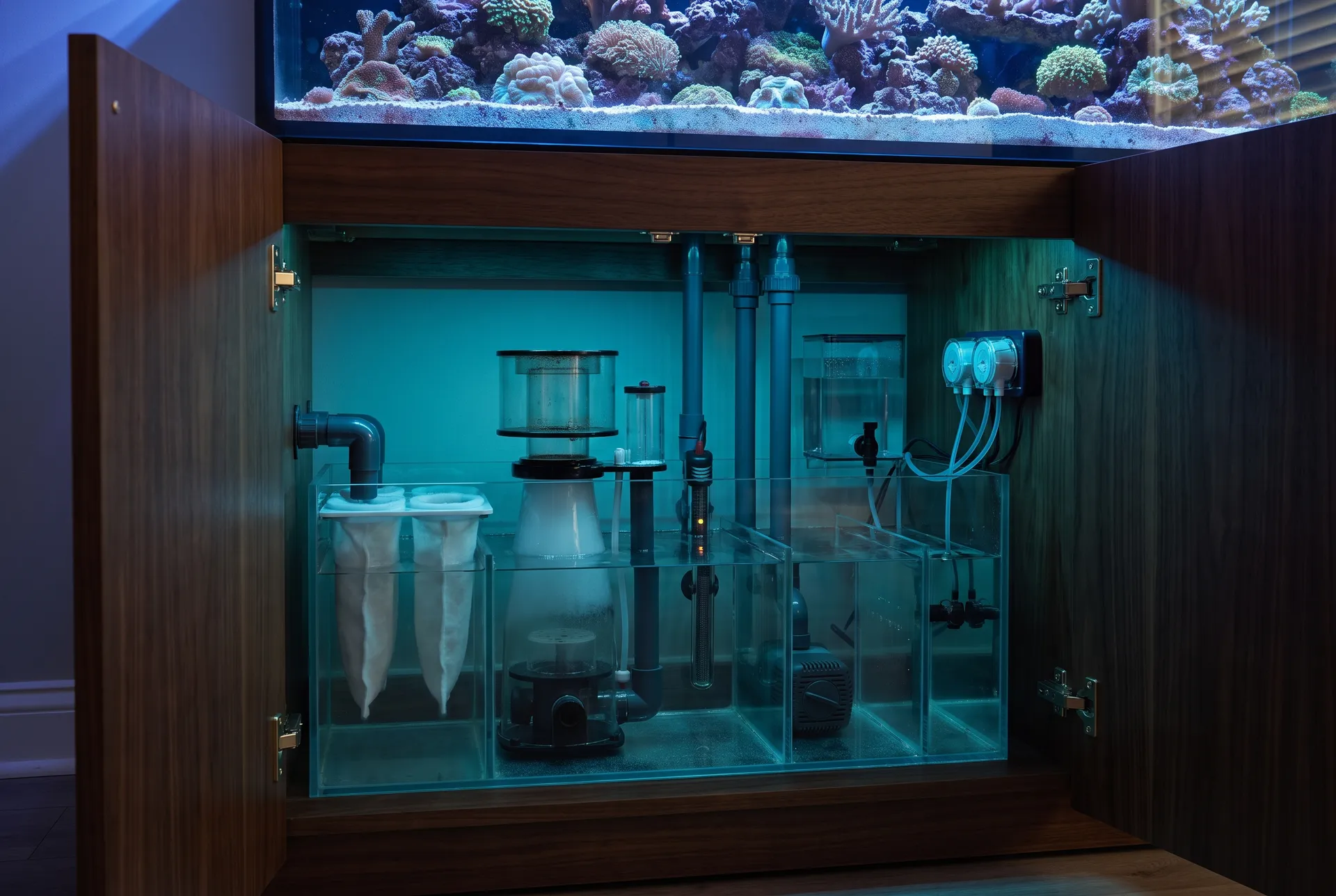
The lobby display LR-01, cut through from its lighting to the cabinet below. Scroll, and each piece of its life-support equipment lights in turn with the word for it; every word opens its definition.
- 1LED lightingLight for the corals, on its own cycle
- 2CanopyHides the lights, keeps the splash in
- 3Display aquariumWhat the guests see
- 4OverflowSkims the surface, drains to the sump
- 5Filter socksCatch particles first
- 6Protein skimmerLifts waste out as foam
- 7HeaterHolds the temperature
- 8Return pumpSends clean water back up
- 9Return lineReturns it to the display
- 10Top-off reservoirReplaces what evaporates
- 11Dosing pumpAdds measured supplements
60 terms
No term matches. Try a shorter word, or clear the box to see them all.
Saltwater and freshwater displays
The kinds of aquarium a care company looks after in a client’s venue.
6 terms- Saltwater aquarium
An aquarium holding seawater, natural or mixed from salt, for marine fish, corals and invertebrates. Its salinity is checked at every visit, because evaporation raises it.
Also called marine aquarium
- Reef aquarium
A saltwater aquarium built around living corals, which need steady chemistry and strong lighting. It is usually the display that asks most of a care company.
- FOWLR
A saltwater aquarium with fish and rock but no corals. It is usually simpler to keep stable than a reef aquarium.
Also called fish only with live rock
- Freshwater planted aquarium
A freshwater display designed around living plants, often fed with CO₂ and fertiliser. A drop checker — a small glass vial whose colour shifts — gives a rough read of the CO₂ at a glance.
- Aquascaping
The design and arrangement of rock, wood, substrate and plants in an aquarium. Many care contracts begin when an aquascaper finishes the build and keeps the maintenance.
- Display aquarium
An aquarium installed as a feature for a venue’s guests, as opposed to a holding or quarantine tank behind the scenes.
Also called feature aquarium
Life-support equipment
The equipment that keeps a display running, most of it out of sight in the cabinet.
17 terms- Life support (aquarium equipment)
The equipment that keeps a living system running: filtration, circulation, lighting, temperature control, top-off and dosing.
In Frescalo, each system on the register carries its life-support equipment, so a visit can check it piece by piece.
- LED lighting
The light fixtures over a display, run on a daily cycle the care company sets. Corals depend on them, and lamps lose strength before they fail, so they are replaced on a cycle of their own.
In Frescalo, a lamp change can sit on the Visit Calendar on its own cycle, apart from the weekly visits.
- Canopy
The cover over a display that hides the lights and pipework and keeps splash and jumping fish in.
Also called hood
- Overflow
A box or slot at the top of the display that skims the surface water and sends it down to the sump, so the display’s level never changes.
Also called weir
- Sump (filtration tank)
A tank in the cabinet below the display that holds the filtration and equipment out of sight and adds to the system’s water volume.
- Filter sock
A fabric bag that catches particles as water drops into the sump. It is changed or washed at each visit, before the waste it holds starts feeding algae.
- Protein skimmer
A device in the sump that lifts dissolved organic waste out of saltwater as foam, which collects in a cup that is emptied at the visit.
- Heater and chiller
The equipment that holds the water temperature within the range the care company sets: a heater warms it, a chiller cools it.
- Return pump
The pump that sends filtered water from the sump back up to the display.
- Return line
The pipe that carries the water from the return pump back into the display, usually up the back of the tank and out through a nozzle below the surface.
- Auto top-off (ATO)
A system that replaces evaporated water with fresh water from its own reservoir, so the salinity stays steady between visits. The reservoir’s level is checked and refilled at the visit.
- Dosing pump
A small pump that adds measured amounts of supplements, such as alkalinity or calcium, on a schedule. Its lines and settings are checked at the visit.
- Circulation pump
A pump that moves water around inside the display, so food and waste don’t settle and corals get the flow they need.
Also called wavemaker
- Mechanical filtration
Filter socks, floss or sponges that trap particles. They need changing before the waste they hold becomes a source of nutrients.
- Biological filtration
The bacteria living on rock and filter media that turn ammonia into nitrite and then into nitrate.
- UV sterilizer
A unit that passes water by an ultraviolet lamp to control free-floating algae and microbes. Its lamp loses strength over months, so it is changed on a cycle — makers quote six to twelve months, depending on use.
Also called UV clarifier
- Refractometer
A hand instrument that reads salinity from how light bends through a drop of water.
Water chemistry
What is measured at a visit, and what each reading tells you.
12 terms- Water chemistry
The measured state of the water at a visit: salinity, temperature, pH, alkalinity, nutrients and the rest, depending on the system.
In Frescalo, every reading is one your team takes at the visit, drawn against the range you set — nothing is read live.
Also called water parameters
- Target range
The band the care company sets for each reading on each system; every reading is judged against it. Published ranges disagree with one another, which is why the firm sets its own.
In Frescalo, you set the range for each reading on each system; a reading outside it is flagged when it is entered at the visit.
- Salinity
How much salt the water holds, read as specific gravity — the water’s density compared with fresh water — or in parts per thousand.
Also called specific gravity (SG)
- Alkalinity (KH)
The water’s buffering capacity, which steadies pH and which corals draw on to build their skeletons. In a reef aquarium it is one of the readings that moves fastest.
Also called dKH
- Calcium
A major element that corals and coralline algae take from the water as they grow, so a reef aquarium’s calcium is measured and topped up.
- Magnesium
An element that helps keep calcium and alkalinity in solution in a reef aquarium. It is usually tested less often than alkalinity.
- Nitrate (NO₃)
The end product of biological filtration. It builds up between water changes and feeds algae when it runs high.
- Phosphate (PO₄)
A nutrient that comes in with food and waste and feeds algae when it accumulates.
- Ammonia and nitrite
Toxic waste compounds that show in a new or overloaded system before its filter bacteria catch up.
- Nitrogen cycle
The settling-in period after a new system is set up, while its bacteria establish. Ammonia and nitrite are tested every few days, and fish are added once both read zero; there is no fixed number of weeks.
In Frescalo, a new system can carry closer visits on the Visit Calendar until you sign it off into its regular rhythm.
Also called cycling
- Water change
Taking out part of the water and replacing it with fresh, prepared water to dilute waste and restore what has been used up. The share changed is the firm’s own practice, logged at each visit.
In Frescalo, the share changed is logged with each service visit.
- Salt creep
Dried salt that builds up around a saltwater aquarium’s rim, lid and equipment, cleaned off at the visit.
Living walls
The planting and the water system behind it.
8 terms- Living wall
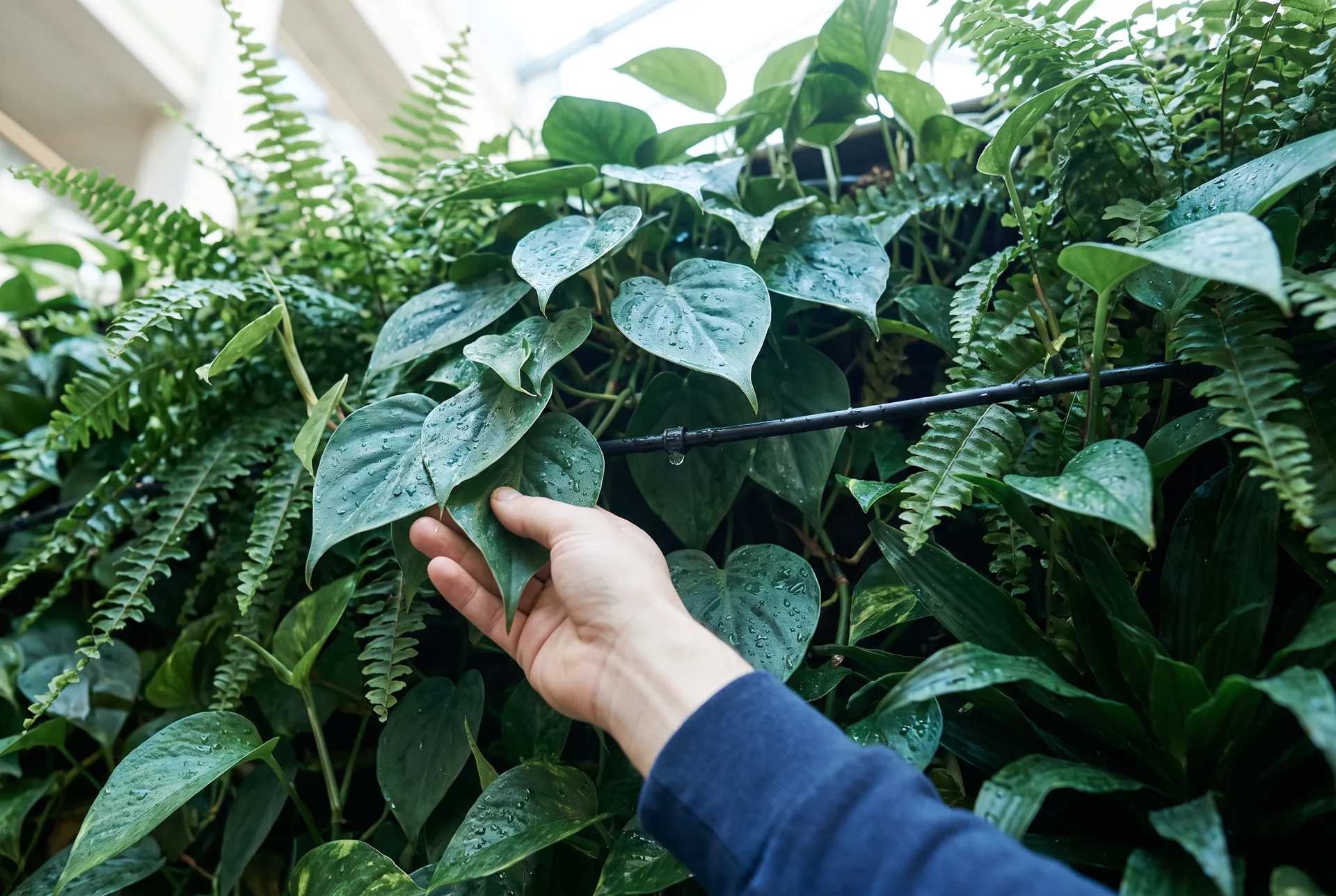
A vertical planted system fixed to a wall, with its own irrigation, reservoir and drainage. Frescalo keeps the system behind the planting: the water, the zones and the visits.
In Frescalo, a living wall is one system with its zones, its irrigation, reservoir and dosing, and its own visits.
Also called green wall, vertical garden
- Hydroponic living wall
A living wall grown without soil, fed by a recirculating nutrient solution pumped up from a reservoir.
- Irrigation controller
The timer or controller that runs a living wall’s watering cycles; its run times are reviewed as the seasons change.
- Drip line
The thin pipe along each row of a living wall, with small emitters that drip water and nutrients into the planting. A blocked emitter shows first as a dry patch.
- Reservoir (living wall)
The tank that holds a living wall’s water or nutrient solution; its level is topped up and logged, and its EC and pH are checked at the visit.
- Nutrient dosing
The measured feed added to a living wall’s water, by a dosing unit or by hand, at a ratio the care company sets.
- EC (electrical conductivity)
A measure of how concentrated a living wall’s nutrient solution is, read with a meter in the reservoir.
- Plant health by zone
A living wall’s condition recorded section by section — growth, pests, a dry or failing patch — so a problem can be traced to its line.
In Frescalo, each zone’s observations and photos are logged at the visit.
Koi and ornamental ponds
A pond’s fish, its water and its year.
5 terms- Koi pond
An outdoor pond built for koi, with a pump, filtration and often a UV clarifier, cared for through a seasonal year.
Frescalo is built to hold a koi pond as one more system on the register, with seasonal visits that follow your hemisphere.
- Pond filter
The filtration that keeps a pond’s water clear and its waste broken down, cleaned on the firm’s cycle and never all at once, so its bacteria survive.
- Spring start-up
The visit that wakes a pond after winter: cleaning, restarting the filtration, then bringing back feeding gradually as the water warms.
- Leaf netting
The net laid over a pond in autumn so falling leaves stay out of the water and don’t rot in it.
- Winter shutdown
The pond’s winter routine: feeding stopped as the water cools, flow reduced and a hole kept open in any ice.
Fish, corals and the record
The living things, and the record a care company keeps of them.
12 terms- Livestock (fish, corals and invertebrates)
In the aquarium trade, the fish, corals and invertebrates living in a system — counted and looked over at each visit.
In Frescalo, each system’s fish, corals and invertebrates sit on the register and are counted at the visit.
- Bioload
The amount of waste the fish, corals and invertebrates produce, which the filtration has to keep up with.
- Acclimation
Bringing new fish, corals or invertebrates slowly to the system’s water before they are released into it.
- Coral bleaching (in an aquarium)
Corals losing their colour under stress. At a visit it is recorded as an observation with a photo, never as a diagnosis.
- Service visit
A scheduled visit to a client’s system, logged as a record of what was done, measured and seen.
In Frescalo, every service visit is logged as an aquarium husbandry record, photos included.
- Aquarium husbandry log
The trade’s name for the record of feeding, cleaning, readings and observations on an aquarium.
- Incident
Non-routine work on a system, from a pump that stops to a loss, recorded from the moment it is reported to the visit that closes it.
In Frescalo, everything on the record is marked routine, attention needed or incident.
- Stewardship Report
Frescalo’s client report: the period’s visits, readings, photos, incidents and work, for aquariums and living walls alike, sent by the care company in its own name.
It leaves when asked, whenever you decide or on your own timetable, as a PDF attachment or a link to the report — never by itself.
- Stewardship Plan
Frescalo’s name for a client’s maintenance contract: the systems covered, the visit rhythm, the report and the monthly price.
In Frescalo, the plan is invoiced monthly, and its visits fill the Visit Calendar.
- Aquarium maintenance contract
The recurring agreement that sets how often the visits come, what each one covers and the monthly price; with a leased display it often covers the equipment too.
- Aquarium leasing
A model in which the care company supplies, installs and maintains a display for a monthly fee, instead of selling it.
In Frescalo, a leased display is a system on the register with its own recurring monthly invoice.
Also called aquarium rental
- Work Record
One finished job written down — its steps and times, a photo before and after, parts, time on site and the technician’s note — filed on the system’s record and sent to the client only if they ask or you decide to.
In Frescalo, every finished job keeps one; the invoice never waits for it.
Frescalo keeps the record of what your team checked, measured, changed and reported at each visit, against the ranges you set. Living systems carry inherent biological risk; Frescalo documents care - it does not guarantee outcomes.
Keep exploring
Where the words are put to work
- Living system recordsThe register, the service visit, readings against your range, fish, corals and zones, incidents.See the visit
- Stewardship reportsWhat the report holds, how it reads, how it reaches your client.See the report
- FAQHow often systems are serviced, what a contract covers, and what Frescalo never claims.Read the FAQ
Founding access
The words, and the record behind them.
Leave your name and work email to claim founding access, confirm the address, and you’ll hear the day Frescalo opens. Nothing else arrives before you confirm.
Launching with a 14-day free trial. No card needed.
Coming soonWaitlist open
Claim early access